 1 of 1
- RadioActive
- Moderator
 Offline

Why Is There No "Channel 1" On Your TV Set?
"Channel 1 was real. American stations broadcast on it. And then the government took the frequencies away and gave them to somebody else, and rather than renumber the remaining channels, the whole country simply agreed to start counting at two and has done so ever since."
It also had transmission issues that made putting stations on there a real problem. Which is a shame. What TV station would not want a slogan where they could honestly say "We're no. 1?"
American televisions have no channel 1 because the government took it away in 1948 and nobody renumbered
- Paul Jeffries
- Member
Offline

Re: Why Is There No "Channel 1" On Your TV Set?
Sounds like it would've been heaven for DXers. 
PJ
ClassicHitsOnline.com...The place where all the cool tunes hang out!
- mace
- Member
Offline
Re: Why Is There No "Channel 1" On Your TV Set?
I can remember when there was one antenna for ch 2-6 and a second for ch 7-13. When WKBW signed on Nov 30, 1958. nobody could receive it in Toronto because they all had low VHF antennas. Having to shell out good dollars for a second antenna to receive only one channel was a tough sell. Eventually the "2/4/7" antenna was introduced that covered the entire VHF spectrum.
- tvguy
- Member
Offline
Re: Why Is There No "Channel 1" On Your TV Set?
Mace, there's another part to that story. In the early 1950's there was a privately owned station WBUF on Channel 17 from 1953 to 1955. I It failed financially very quickly out of the gate. NBC bought the licence and increased the power significantly to 1 million watts ERP which even for the 1950's was massive. There was a "channel 17" (UHF) antenna sold in Toronto and there were "single channel" UHF converters that were sold. We had one of those primitive UHF converters - which was manufactured on Miranda Avenue in Toronto. One of my early memories was my father and uncle pointing the UHF antenna on the roof of our house on Vaughn Road for Ch. 17. NBC operated the station for - approximately 3-1/2 years, as it also failed financially. It appears that WGR and WBUF carried NBC programs during some of that time. But the writing was on the wall. In October 1958, NBC shuttered WBUF and within weeks, WKBW came on the air. WBUF operated as an NBC Station from March 1955 to October 1958. My recollection is that WKBW signed on as an ABC station on November 30, 1958. I remember watching it the night it signed on. It broadcast "The Wonderful World of Disney" as the lead program that Sunday night. I suspect we had a 2,4,7 antenna by that time - or the signal came in well enough on our older VHF antenna. We moved out to burbs of North York in 1959, and I remember always having reception of WKBW there, so I suspect by Jan or Feb 1959, all (new) standard TV antenna installations were 2-4-7 antennas. For those interested in the history of WBUF and the revolving door of channel affiliations in Buffalo in those early days, this link might be of interest.
Last edited by tvguy (Yesterday 6:09 pm)
- RadioActive
- Moderator
Offline
Re: Why Is There No "Channel 1" On Your TV Set?
tvguy wrote:
There was a "channel 17" (UHF) antenna sold in Toronto and there were "single channel" UHF converters that were sold. We had one of those primitive UHF converters - which was manufactured on Miranda Avenue in Toronto.
We had one of those converters when I was a kid, something siimlar to the ad below, which ran in the Nov. 18, 1956 Buffalo edition of TV Guide. Wish I still had it for nostalgia sake, but it's long gone. 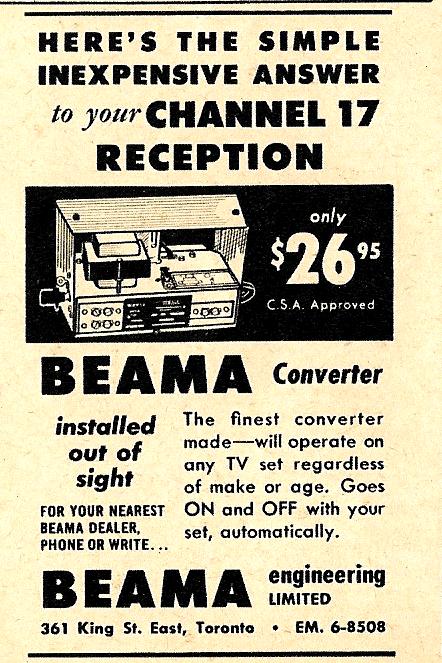
- •
 Thread Starter
- MJ Vancouver
- Member
Offline
Re: Why Is There No "Channel 1" On Your TV Set?
In the digital age, although no stations I’m aware of in the US or Canada are using virtual channel 1, there is one part of North America that is using it, and that’s Mexico.
XHDF-TV in Mexico City broadcast on Channel 13 in the analog era and was also known as Azteca 13. After the switch to digital, they moved their virtual channel from 13.1 to 1.1, and rebranded as Azteca Uno. Repeaters/affiliates across the country also followed suit and use channel 1.1. Some of these stations are near the US border, so if you’re in San Diego you can get (virtual) channel 1 as the Azteca Tijuana affiliate XHJK uses it.
Last edited by MJ Vancouver (Yesterday 7:47 pm)
- Evuguy
- Member
Offline
Re: Why Is There No "Channel 1" On Your TV Set?
That's actually pretty smart when you think about it. First channel on your dial is Azteca. A bit bimilar to TVO mandating that cable co's in Ontario place their service on ch.2.
- Evuguy
- Member
Offline
Re: Why Is There No "Channel 1" On Your TV Set?
Of interest: Below is a link to a chart showing the VHF TV band plans from around the world. It includes our long defunct channel 1. Many countries had transmissions below 50MHz. Some also made use of the 88-108MHz FM radio spectrum. Then there is the French, who sported TV channels 14MHz wide, due to their 819 line HD standard that was in use into the 1980's.

- Fitz
- Member
Offline
Re: Why Is There No "Channel 1" On Your TV Set?
After the arrival of channel 29 in Buffalo our family ( early 70's) bought a UHF converter that looked something like this: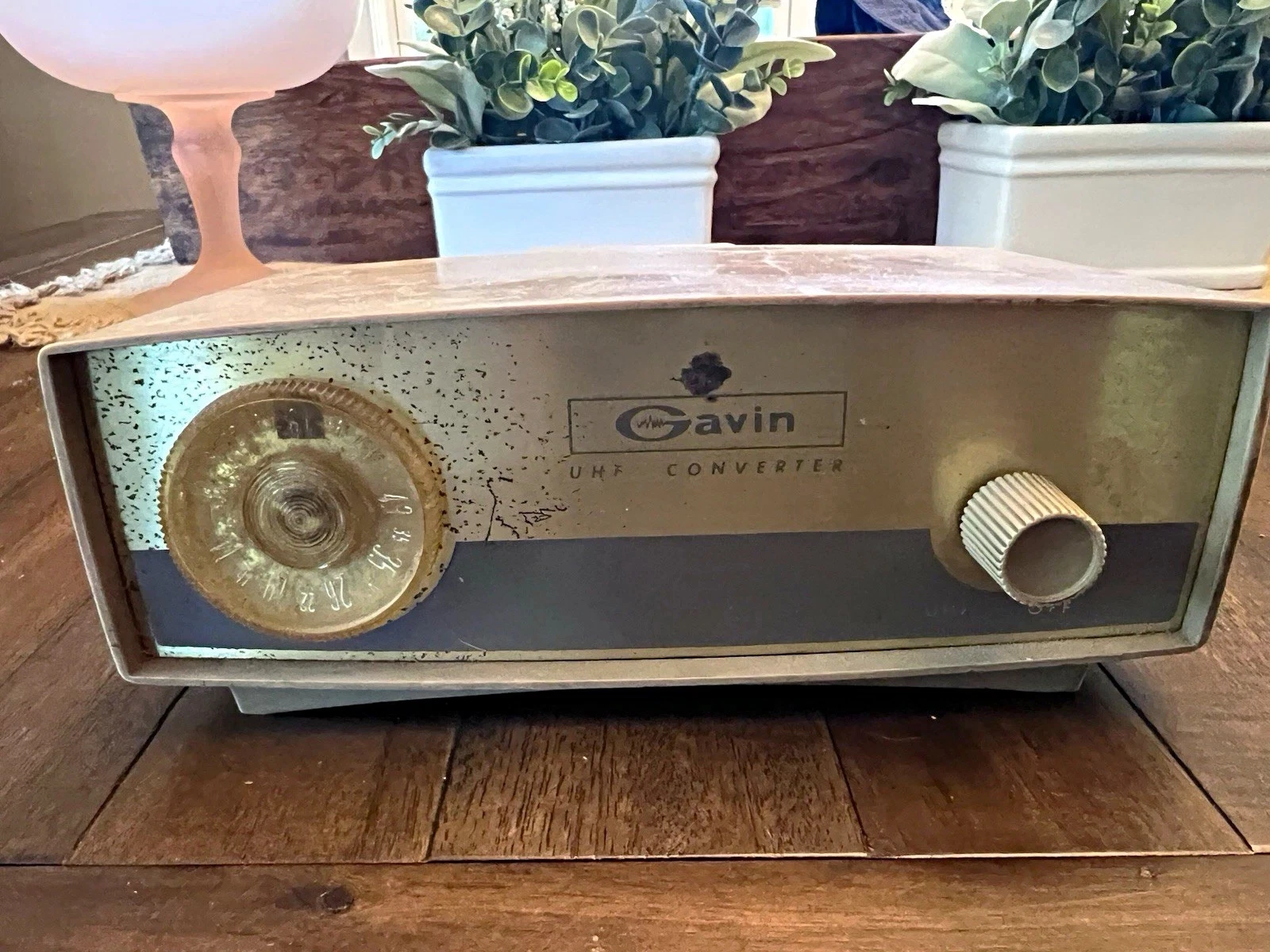
Cool Airchecks and More: