 1 of 1
- RadioActive
- Moderator
 Offline
Ancient Ad Wonders “When Will TV Come To Canada?”
This ad seems incredible today, but back in 1945, I’m guessing enough people had heard about television to wonder if it would ever actually happen here. (WBEN-TV in Buffalo went on the air in 1948, just three years later.)
The answer didn’t come until 1952, when the CBC signed on in both Montreal and Toronto, marking the first regular TV broadcasts in Canada.
But you gotta love GE for putting out an ad for something that in many ways, hadn’t even really been perfected yet and no one had access to, seven years before Canada actually got its first stations. 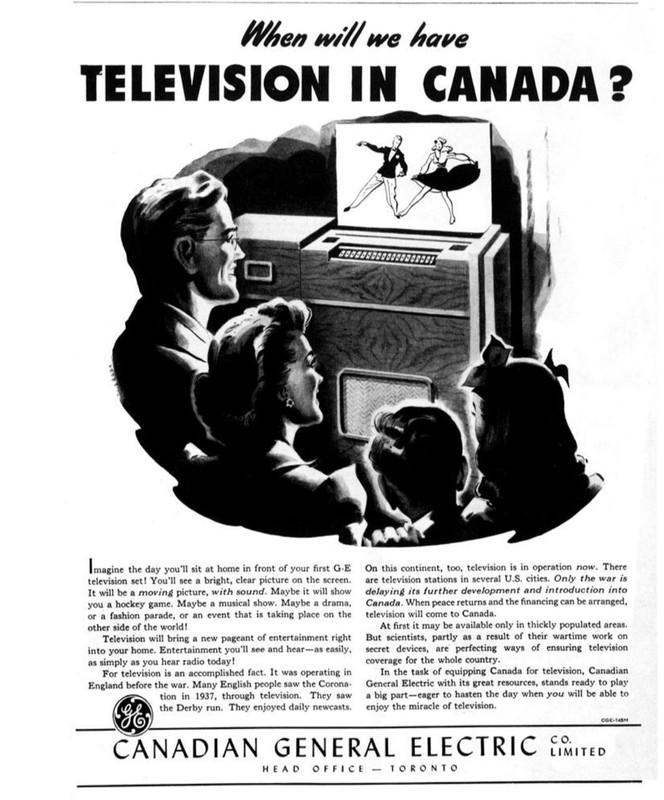
- mace
- Member
Offline
Re: Ancient Ad Wonders “When Will TV Come To Canada?”
I am sure the CBC Television could have been up and running in 1948 or 49. But in typical Canadian fashion the Federal Government hummed, hawed and dithered before making a decision in 1952 that television was a good idea. Meanwhile viewers that could afford a set got addicted to what WBEN was offering. Judging by the explosion of antennas pointed to Buffalo in the 50's, 60's and 70's GTA residents preferred what ch 2,4 and 7 were broadcasting over what 6, 9 and 11 had available. The only exception might be HNIC and local news.
- tdotwriter
- Member
Offline
Re: Ancient Ad Wonders “When Will TV Come To Canada?”
mace wrote:
I am sure the CBC Television could have been up and running in 1948 or 49. But in typical Canadian fashion the Federal Government hummed, hawed and dithered before making a decision in 1952 that television was a good idea. Meanwhile viewers that could afford a set got addicted to what WBEN was offering. Judging by the explosion of antennas pointed to Buffalo in the 50's, 60's and 70's GTA residents preferred what ch 2,4 and 7 were broadcasting over what 6, 9 and 11 had available. The only exception might be HNIC and local news.
Apparently, some areas in Ontario still used 25 Hz AC power in some areas as late as the 1950s (fed from the Niagara Falls hydroelectric plant) as opposed to the 60 Hz which is ubiquitous in North America in modern times (50 Hz in most of Europe and many other parts of the world).
Simply put, given the way analog television works, this would have been a major technical barrier in terms of the production equipment, transmitters, other associated infrastructure and the TV sets themselves. Given the CBC's status as a public-service broadcaster, it makes sense that they would have waited a few years for the power grid to be universally and natively compatible with all the equipment and infrastructure on their end to an extent necessary for television to become a truly mass medium beyond just the domain of early adopters who were also lucky enough to already be on 60 Hz power. Some, if not many of the first Rogers "batteryless" AC-powered radios were made for 25 Hz AC.
Last edited by tdotwriter (August 2, 2026 9:40 am)
- paterson1
- Member
Offline
Re: Ancient Ad Wonders “When Will TV Come To Canada?”
Canada began experimenting with television in 1931 with a mechanical version which was common in the late 20's and 30's. The first broadcast experiments began in 1932. The war stopped everything in 1939.
I am not as critical of the 1952 start of regular broadcasting in Canada. We were still recovering after WWII and had a huge debt. The government rightly felt there were more important things like housing for returning soldiers and helping them get on with life. Right or wrong TV wasn't the priority. Canada was still moving from a wartime economy in 1948. The country was carrying a big debt from the war and was not as rich and a physically larger country with a much smaller population as our neighbour south.
Few people actually had TV's in the late 40's/early 50's. Mostly affluent families that had an interest in the new service. The explosion of TV sales in Southern Ontario didn't happen with channel 4. TV's sold in big numbers in Southern Ontario and the Montreal/Ottawa area after CBC went on air. When CBC came on in Toronto in 1952, Buffalo still only had channel 4. Channel 2 WGR came on in August 1954 and WKBW November 1958, years after the debut of CBLT.
- RadioActive
- Moderator
Offline
Re: Ancient Ad Wonders “When Will TV Come To Canada?”
And let's not forget WBUF, Channel 17 in Buffalo, which came on the air in 1953 and stayed there until Feb. 1955. It returned as an NBC O&O (owned and operated) station in 1955 and died again for good in October of 1958. It suffered because most sets did not have UHF and required a special converter to get stations in that band.
For dozens of years, of course, it's been WNED, Buffalo's PBS station.
- •
 Thread Starter
- RadioActive
- Moderator
Offline
Re: Ancient Ad Wonders “When Will TV Come To Canada?”
And of course, we can't forget the ignominious debut of CBC-TV Toronto, when it showed its very first picture in 1952.
Some tech put in the slide they wrong way, so the first thing viewers saw was an upside down and backwards CBLT logo. The perfect debut for the CBC!
The best part of the story, though, is that when CBLT moved off of Channel 6 to Channel 5 in 1972, they deliberately signed on at 6 AM with their current logo backwards - but only for a few seconds. In those pre-DVR days, I remember getting up early to watch that official channel change and I may have been one of the few to see it happen. It quickly flipped back to the proper framing, but I'm pretty sure someone remembered that initial broadcast and did it in tribute. 
- •
Thread Starter- RadioActive
- Moderator
Offline
Re: Ancient Ad Wonders “When Will TV Come To Canada?”
By the way, here's the first thing Canadians saw the night CBC Toronto debuted on Channel 9 back then. It was Sept. 8th, 1952.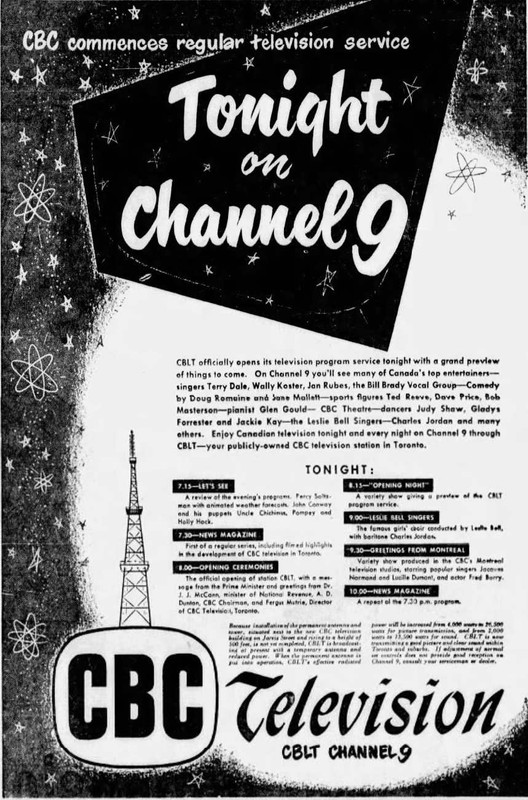
- •
Thread Starter- Evuguy
- Member
Offline
Re: Ancient Ad Wonders “When Will TV Come To Canada?”
Re: 25 cycle power - my father recalled when he lived in Toronto's High Park neighbourhood, the trucks parked on the street with men converting each household's appliances to operate at 60Hz. This would be around 1955. He recalled that you could notice the light flicker when run on 25 cycles.
If interested in electricity generation and distribution, this website below will be an interesting read on how the migration was handled. Along with 25Hz, there was even a 66 2/3Hz frequency standard in Ontario back at that time. The 60Hz conversion project wrapped up in 1959 in Leaside, after starting in 1949.
As for the delay of television arriving in Canada, I would speculate it had more to do with the technical standard that Canada was going to adopt (likely a no-brainer, but still). Britain had a standarized public television broadcasting system in 1937, before the US did, using the Marconi-EMI 405 line monochrome standard. The NTSC monochrome standard came along later in 1941, later tweaked to accept colour in 1953.
As a sidenote, if you are interested in E-Skip, the film clip below shows BBC TV being received at the RCA's research labs in 1938 at Long Island, NY. The image is pretty soft, but anyone who has DX'd in an E-Skip event will recognize the selective fading and multipath. This is possibly the first TV E-Skip capture ever received. I could only imagine how exciting that must have been for those on the receiving end, watching TV from thousands of miles away on what was then known as the Ultra Short-Wave band (around 40MHz). I recall reading that decades later, 405 line BBC TV was received in Australia.