 1 of 1
- RadioActive
- Moderator
 Online!
TV Signals Used To Send More Accurate GPS
You probably get your GPS signals off a satellite. But if a Boston start-up has its way, you may soon be receiving them off of your local TV station.
The firm, Edgebeam, is using the same technology television stations employ to send out their subcarriers to put out a signal to GPS receivers. They claim it's not only cheaper, but avoids the need for satellites, allows access to stronger signals and is so accurate, it can pinpoint a location within inches of where you want to go.
It would mean getting a new receiver, so for now, the test launch is being aimed at larger companies.
"Using the same signals carrying TV programming, Edgebeam transmits a precise timing signal known as the Broadcast Positioning System, or BPS, that can be used to locate a position with an accuracy of inches, even if GPS signals are unavailable...
"The signals from TV towers are much stronger than signals from satellites, making them less prone to interference or jamming."
The start-up also believes it can use the technology to transmit TV shows to a cell phone, so you could, say, conceivably transmit the Super Bowl to your had held device.
Sounds a bit like pie-in-the-sky, but at least four major TV station ownership groups are backing the idea. It's too soon to say if the concept could be brought to Canada if it works as advertised.
Boston startup Edgebeam wants to use TV airwaves to replace GPS
- tdotwriter
- Member
 Offline
Re: TV Signals Used To Send More Accurate GPS
This would really be best used as a redundant or contingent system alongside the cellular signal triangulation which is the standard for smartphones nowadays. Ideally, modern vehicle infotainment systems could apply satellite, cellular and this new terrestrial TV signal tracking standard in one package.
Retaining satellite tracking for the devices that support it, such as an "old-fashioned" 2000s-2010s-style satellite GPS tracking unit is a matter of public safety and national security IMHO. If the "manure" really hits the fan, I think satellite technology, although not immune to jamming or sabotage will be one of the most likely things to remain functional.
Another consideration: My understanding is that terrestrial VHF/UHF TV signals can be very prone to sometimes dramatic fluctuations in signal strength depending on a number of factors, especially location and weather conditions. I think this would negatively affect the accuracy of the tracking, as the reciever would "think" that it's closer or further from the transmitter being used as the reference point. I also don't quite know how the implied use of only a single transmitter as a reference point for tracking would work. Cell signal tracking relies on the use of more than one cell repeater station to triangulate the location of the phone, and even satellite tracking relies on contact with multiple satellites being maintained from what I understand.
The wording in the article at least strongly suggests that the system requires the transmission of an ATSC 3.0 (Nextgen TV) signal. If that's the case, that's a big barrier to adoption in and of itself, especially here in Canada where our broadcasters seem disinterested in any further innovations to broadcast TV beyond the now-mostly completed transition to digital.
The problem with ATSC 3.0 really isn't the standard itself, but the tendency for participating broadcasters to "protect" some or all of the signals with Digital Rights Management, which can curtail the ability to record programs (on devices with DVRs) and even break compatibility with ATSC 3.0-enabled tuners, but this deserves another topic of its own.
Last edited by tdotwriter (March 18, 2026 8:32 am)
- RadioActive
- Moderator
Online!
Re: TV Signals Used To Send More Accurate GPS
The threat of DRM is the main reason I'm so against Next-Gen TV. U.S. courts ruled decades ago, when the Sony Betamax first came out, that taping shows for later viewing off of VCRs was completely legal, even as producers warned it would lead to piracy. They used to put a non-copying signal on the tapes to make it harder to dub a movie released on a tape, but watching "Friends" later in the night because you missed it at 8 PM on NBC was fine.
I kind of feel it's the same old argument. And that it's already been settled. Besides, as I discovered back in the days of my C-Band satellite dish, if they find a way to scramble or impede a recording of a movie or TV show, someone will quickly find a way to defeat it.
So why not just leave things as they are instead of going through this all over again?
- •
 Thread Starter
- RadioActive
- Moderator
Online!
Re: TV Signals Used To Send More Accurate GPS
Speaking of home VCRs, it's pretty amazing to consider that they were talking about the technology as early as 1969. And the plans were very different than what most of us had a few years later. 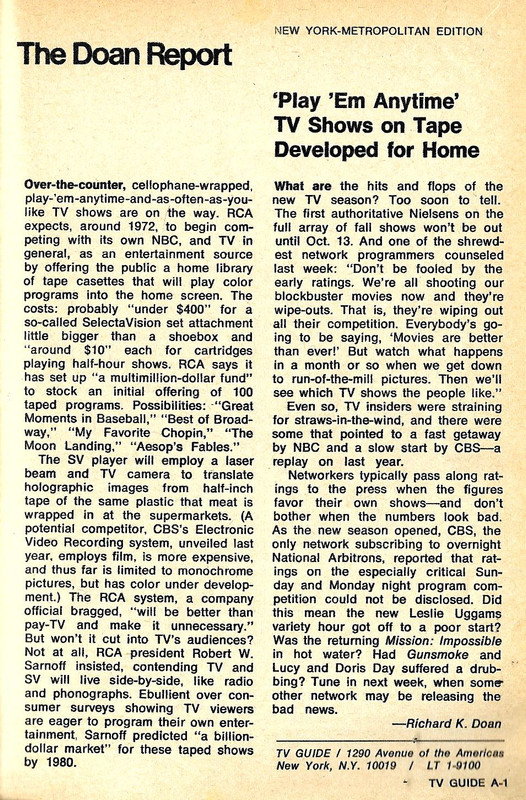
- •
Thread Starter- RadioAaron
- Member
Offline
Re: TV Signals Used To Send More Accurate GPS
tdotwriter wrote:
The problem with ATSC 3.0 really isn't the standard itself, but the tendency for participating broadcasters to "protect" some or all of the signals with Digital Rights Management, which can curtail the ability to record programs (on devices with DVRs) and even break compatibility with ATSC 3.0-enabled tuners, but this deserves another topic of its own.
This is a false concern, no matter how may times it is repeated here. This is already possible with cable, though which the vast majority of broadcast TV is consumed, especially in Canada. It makes no sense that broadcasters would be waiting for the small minority who use OTA to "turn it on." They can do it; they almost never do.
It's moot anyway, as broadcast TV will be long-dead before "NextGen" TV nears anything resembling critical mass, which is never.
There are likely many great uses for being able to broadcast mass amounts of data, but beaming Friends reruns to your TV isn't it.
- Fitz
- Member
Offline

Re: TV Signals Used To Send More Accurate GPS
This is a false concern, no matter how may times it is repeated here. This is already possible with cable, though which the vast majority of broadcast TV is consumed, especially in Canada. It makes no sense that broadcasters would be waiting for the small minority who use OTA to "turn it on." They can do it; they almost never do.
It's moot anyway, as broadcast TV will be long-dead before "NextGen" TV nears anything resembling critical mass, which is never.
There are likely many great uses for being able to broadcast mass amounts of data, but beaming Friends reruns to your TV isn't it.
I may be missing something as you usually know what you are talking about but is Next Gen not broadcast so how could it reach critical mass if broadcast TV is dead.
and I know you said never but still.
Last edited by Fitz (March 18, 2026 10:45 am)
Cool Airchecks and More:
- RadioActive
- Moderator
Online!
Re: TV Signals Used To Send More Accurate GPS
Ironic timing - this came out the morning of this thread.
81% of Over-the-Air Viewers Would Purchase a NEXTGEN TV Converter Box to Preserve Access to Free Local Television
- •
Thread Starter- RadioAaron
- Member
Offline
Re: TV Signals Used To Send More Accurate GPS
This is a false concern, no matter how may times it is repeated here. This is already possible with cable, though which the vast majority of broadcast TV is consumed, especially in Canada. It makes no sense that broadcasters would be waiting for the small minority who use OTA to "turn it on." They can do it; they almost never do.
It's moot anyway, as broadcast TV will be long-dead before "NextGen" TV nears anything resembling critical mass, which is never.
There are likely many great uses for being able to broadcast mass amounts of data, but beaming Friends reruns to your TV isn't it.I may be missing something as you usually know what you are talking about but is Next Gen not broadcast so how could it reach critical mass if broadcast TV is dead.
and I know you said never but still.
Probably not worded very well. The business model for broadcast television will be dead before using this new technology for it has the chance to catch on.
- Evuguy
- Member
Offline
Re: TV Signals Used To Send More Accurate GPS
I think some of you are aware that Humber Polytechnic has been carrying out ATSC 3.0 broadcast tests in Toronto for a few years now, via their B2C lab facility. They have posted a couple of presentation videos on BPS, recorded back in 2024. They are saying that GPS jamming is a genuine concern and BPS operating within 3.0, when fully deployed across the US, would alleviate this threat. They stated that a BPS receiver operating with an antenna at 1.5m height should be able to see up to 17 different BPS feeds.
Introduction to ATSC 3.0 Broadcast Positioning System (BPS)
Overview of risks with loss of GPS service
You can do your own search on jamming, if interested. Note it is illegal to jam GPS signals.
- mace
- Member
Offline
Re: TV Signals Used To Send More Accurate GPS
Speaking of home VCRs, it's pretty amazing to consider that they were talking about the technology as early as 1969. And the plans were very different than what most of us had a few years later.
Looking at the second column regarding CBS's slow ratings start to the 1969/70 season. They needn't have worried. By the end of the season, CBS had 5 of the top 10 and 12 of the top 20. However. NBC had #1 Laugh-in and #3 Bonanza.