 1 of 1
- rk12
- Member
 Offline
Re: "We don't need AM radio in cars anymore. Let it die."
Why all the fuss about about including AM when it cost very little.If the car makes interference so be it.HD radio has much larger cost .Camping this year ,most Toronto of AMs were available,only 1 local fm station.CBC radio 1 FM repeater very poor.AM 740 crystal clear.
- RadioAaron
- Member
Offline
Re: "We don't need AM radio in cars anymore. Let it die."
rk12 wrote:
Why all the fuss about about including AM when it cost very little.If the car makes interference so be it
Because the car manufacturers care about user experience. If that particular function just provides buzzing and static, consumers will blame the car. Even more, most consumers who accidentally activate the feature won't understand what they've done wrong, and again, blame the car.
If it costs "very little" to include AM, but doing so has no impact on sales, it's a wasted cost.
- RadioActive
- Moderator
Offline

Re: "We don't need AM radio in cars anymore. Let it die."
Instead of eliminating it altogether, how about making it an option, like heated seats? Pay a little more and get AM. If you don't want it, you don't have to shell out anything for it. Seems like a solution that would work for everyone.
- Paul Jeffries
- Member
Offline

Re: "We don't need AM radio in cars anymore. Let it die."
Instead of eliminating it altogether, how about making it an option, like heated seats? Pay a little more and get AM. If you don't want it, you don't have to shell out anything for it. Seems like a solution that would work for everyone.
When my parents bought a car back in the 1970s, FM was considered an add-on option as most cars came with just a standard AM radio.
PJ
ClassicHitsOnline.com...Toronto's ORIGINAL classic hits station!
- RadioAaron
- Member
Offline
Re: "We don't need AM radio in cars anymore. Let it die."
Instead of eliminating it altogether, how about making it an option, like heated seats? Pay a little more and get AM. If you don't want it, you don't have to shell out anything for it. Seems like a solution that would work for everyone.
Sure. But that option would end up being very expensive as the demand would be miniscule.
- RadioActive
- Moderator
Offline
Re: "We don't need AM radio in cars anymore. Let it die."
Instead of eliminating it altogether, how about making it an option, like heated seats? Pay a little more and get AM. If you don't want it, you don't have to shell out anything for it. Seems like a solution that would work for everyone.
Sure. But that option would end up being very expensive as the demand would be miniscule.
I'd pay for it, but yes, I'd almost certainly be in the minority.
In my very first car, a Dodge Colt, I paid extra to get a cassette player put in because all my radio stuff was saved in that format.
- Saul
- Member
Offline
Re: "We don't need AM radio in cars anymore. Let it die."
Instead of eliminating it altogether, how about making it an option, like heated seats? Pay a little more and get AM. If you don't want it, you don't have to shell out anything for it. Seems like a solution that would work for everyone.
Sure. But that option would end up being very expensive as the demand would be miniscule.
I'll be sure to get AM included in the radio that comes with my next horse and buggy.
- Skywave
- Member
 Online!
Re: "We don't need AM radio in cars anymore. Let it die."
This whole debate is crazy. Car manufacturers want to delete it because then they won't get complaints about self-induced interference in electric cars.
The reality is that AM/FM/HD capability is embodied in one single chip from several manufacturers. It's more a question of what functionality you enable or disable. The receiver can be the same. The Skyworks chip, for example, costs $13.15 CAD in quantities. How many pennies would be saved by leaving out AM capability?
In the words of Casey Stengel, "you can look it up".
TEF665X | DSP-Based Radio Tuner One-Chip | NXP Semiconductors
Si4682 Single-Chip, FM/HD Radio Receiver
TDA7708 | Product - STMicroelectronics
- Aytononline
- Member
Offline
Re: "We don't need AM radio in cars anymore. Let it die."
AM radio is slowly becoming something you only get in the city's, but this is also the place where you have the biggest issues. Right now I need AM radio for 680 News, after that its hard to justify the need to have it in my car.
On a side note, I never understood why CFRB never tried to copy 680 by having more news and less talk. I think there ratings would be higher then what they have now.
- RadioActive
- Moderator
Offline
Re: "We don't need AM radio in cars anymore. Let it die."
AM radio is slowly becoming something you only get in the city's, but this is also the place where you have the biggest issues. Right now I need AM radio for 680 News, after that its hard to justify the need to have it in my car.
On a side note, I never understood why CFRB never tried to copy 680 by having more news and less talk. I think there ratings would be higher then what they have now.
Do you have HD FM in your car? If so, 680 News is piggybacked on the Kiss 92.5 signal and you won't need AM at all.
As for all news, does anyone remember that CFTR beat 640 to the punch on that format? Corus was ready to change what was then called CHOG to all news, when 'TR beat them to it by a matter of days. There was no way the latter station could launch it after their competitors did it first. 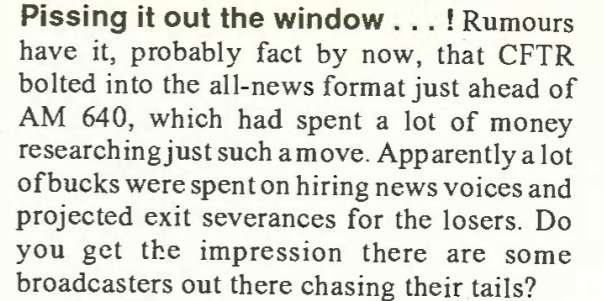
- darcyh
- Member
Offline
Re: "We don't need AM radio in cars anymore. Let it die."
A short sighted article in my opinion. Watt for watt you cannot beat medium wave for long range coverage. Of course it is impacted by mostly man made electrical noise and lightening. My grandkids were surprised when I showed them how you can detect a thunder storm approaching by listening to AM and the lightening static. Not many people are aware of this. Although radio in general through its own mismanagement / cost cutting has lost the coveted trust in reporting breaking news it still comes through when things get tough. I think of WBEN 930 reporting during Buffalo's snow storms and WWL reporting during hurricane Katrina. Any AM station worth its salt will have a backup generator and transmitter to keep it on the air too.
I recently needed to drive my daughter's 2023 Honda CRV. I was unable to find the AM radio but could tune in FM. Apparently there is no AM radio in this vehicle. Around here (near Grand Bend) the FM stations have unappealing programming so I listen to AM. There are a few stations worth tuning to: WMIC 660, WXCI 1160, CKLW 800, WJR 760.
I'm in the minority but I would not buy a vehicle without an AM radio.
- RadioActive
- Moderator
Offline
Re: "We don't need AM radio in cars anymore. Let it die."
I'm in the minority but I would not buy a vehicle without an AM radio.
In the words of Smokey Robinson, I second that emotion.
- maybo
- Member
Offline
Re: "We don't need AM radio in cars anymore. Let it die."
I'm in the minority but I would not buy a vehicle without an AM radio.
In the words of Smokey Robinson, I second that emotion.
Third…
-- Chris Mayberry
- RadioAaron
- Member
Offline
Re: "We don't need AM radio in cars anymore. Let it die."
Watt for watt you cannot beat medium wave for long range coverage. .
What about short wave?
- Saul
- Member
Offline
Re: "We don't need AM radio in cars anymore. Let it die."
Watt for watt you cannot beat medium wave for long range coverage. .
What about short wave?
Good point, Aaron. They should put SW into cars, too. And LW.
- RadioAaron
- Member
Offline
Re: "We don't need AM radio in cars anymore. Let it die."
Watt for watt you cannot beat medium wave for long range coverage. .
What about short wave?
Good point, Aaron. They should put SW into cars, too. And LW.
For safety.
- Saul
- Member
Offline
Re: "We don't need AM radio in cars anymore. Let it die."
What about short wave?
Good point, Aaron. They should put SW into cars, too. And LW.
For safety.
I feel safe just thinking about it. Maybe they don't actually have to DO it...
Eureka, I have it! Let's get Fisher-Price on the case...
Last edited by Saul (October 9, 2026 4:27 pm)
- darcyh
- Member
Offline
Re: "We don't need AM radio in cars anymore. Let it die."
Shortwave will not really travel any further than medium wave. The international shortwave stations (the few that are left) often run 500,000 watts into high gain directional antennas - a very power hungry and expensive operation. AM stations in the US and Canada are limited to 50,000 watts. Many run a lot less.
In terms of watt for watt, in the 1930's WLW AM 700 Cincinnati, Ohio ran 500,000 watts for several years. Its AM signal covered much of the USA and Canada. Exactly like shortwave, its groundwave went about 300 miles out as it still does today. I can barely hear WLW during the day but it is there. At night the skywave covers much of the continent. I could pick it up at night in Costa Rica with its existing 50,000 watts. AM (medium wave) travells much like shortwave that's the reason you can hear WSM 650, WSB 750, WBZ 1030 and many others at night.
On the other hand even a powerful FM signal will be difficult to pick up on a portable radio inside a house 40 miles away without farting around with the radio placement and antenna.
Shortwave frequencies run about 1.8 mhz to 28 mhz. Us hams usually know the best bands or frequencies to use based on the time of day. The higher up in frequency you go the less likely the signal will propage as well. Of couse I am being very general in these terms.
Oh sure you can connect to a services on line; I am bemused by all the people with expensive cell phones, costly cell plans and multiple subscriptions. More power to 'em I say. Just don't complain to me about how broke you are.
Last edited by darcyh (October 9, 2026 4:38 pm)
- mace
- Member
Offline
Re: "We don't need AM radio in cars anymore. Let it die."
Shortwave will not really travel any further than medium wave. The international shortwave stations (the few that are left) often run 500,000 watts into high gain directional antennas - a very power hungry and expensive operation. AM stations in the US and Canada are limited to 50,000 watts. Many run a lot less.
In terms of watt for watt, in the 1930's WLW AM 700 Cincinnati, Ohio ran 500,000 watts for several years. Its AM signal covered much of the USA and Canada. Exactly like shortwave, its groundwave went about 300 miles out as it still does today. I can barely hear WLW during the day but it is there. At night the skywave covers much of the continent. I could pick it up at night in Costa Rica with its existing 50,000 watts. AM (medium wave) travells much like shortwave that's the reason you can hear WSM 650, WSB 750, WBZ 1030 and many others at night.
On the other hand even a powerful FM signal will be difficult to pick up on a portable radio inside a house 40 miles away without farting around with the radio placement and antenna.
Shortwave frequencies run about 1.8 mhz to 28 mhz. Us hams usually know the best bands or frequencies to use based on the time of day. The higher up in frequency you go the less likely the signal will propage as well. Of couse I am being very general in these terms.
Oh sure you can connect to a services on line; I am bemused by all the people with expensive cell phones, costly cell plans and multiple subscriptions. More power to 'em I say. Just don't complain to me about how broke you are.
Where do you live that you can receive WLW weakly in daytime? I have often wondered if WLW would have been available even weakly during the day in the GTA in their 500K era. It was because of complaints by CFRB, then at 690, that WLW put a night signal null to the north.
- Radiowiz
- Member
Offline
Re: "We don't need AM radio in cars anymore. Let it die."
As for all news, does anyone remember that CFTR beat 640 to the punch on that format? Corus was ready to change what was then called CHOG to all news, when 'TR beat them to it by a matter of days. There was no way the latter station could launch it after their competitors did it first.
AM 640 was "the new beat of Toronto" at the time. They even had ads running, claiming to become
the News beat of Toronto..." airing just before 680 beat them to it and went all news first.
Last edited by Radiowiz (October 10, 2026 7:07 am)
- Shorty Wave
- Member
Offline
Re: "We don't need AM radio in cars anymore. Let it die."
I'm in the minority but I would not buy a vehicle without an AM radio.
In the words of Smokey Robinson, I second that emotion.
Third…
Ditto.
- Scarboroughbluffsradiof99
- Member
Offline
Re: "We don't need AM radio in cars anymore. Let it die."
If we only had DAB.
AMs would'nt shut down.
CHML could just move to DAB instead of being off air.
- darcyh
- Member
Offline
Re: "We don't need AM radio in cars anymore. Let it die."
.
Where do you live that you can receive WLW weakly in daytime? I have often wondered if WLW would have been available even weakly during the day in the GTA in their 500K era. It was because of complaints by CFRB, then at 690, that WLW put a night signal null to the north.
I live near Grand Bend. WLW can be received here with a very week signal as long as you are away from power lines and other noise makers. The signal is so weak I would not want to listen to it but it is there. An outdoor directional antenna would probably help.
- darcyh
- Member
Offline
Re: "We don't need AM radio in cars anymore. Let it die."
If we only had DAB.
AMs would'nt shut down.
CHML could just move to DAB instead of being off air.
I'm certainly not against digital audio broadcasting (DAB) but like any RF signal it is still governed by frequencies and physics. In Canada the frequency allocation for DAB is in the L Band (according to Google) which is around 1452mhz. This is quite a high frequency and as such the signal will be very line of sight and will not have that much penetrating power into buildings. In my opinion stations would require a lot of power to overcome this limitation.
Other countries like China are using the VHF hi band beginning around 175mhz. This frequency was used for analog TV channels 7 - 13. This band behaves much like the current FM broadcast band of 88 - 108mhz. It would be much more suitable for radio than the L band as mentioned above.
I don't think there are any current plans to use DAB in North America. Arguably a lost opportunity.