 1 of 1
- darcyh
- Member
 Offline
A peek inside a directional AM transmitter shack
Ever wondered how a radio station gets on the air? Here's a peek inside an AM transmitter building. This is a 5 kilowatt day/night operation with a directional pattern that does not change at night. The site has 7 towers which makes it (in my opinion) a relatively complex operation.
Below are the main and back up transmitters. The station uses a Nautel NX5 as its main and the Harris DAX as a back up. Both fairly new reliable solid state units. Many stations have a newer solid state unit as a main and their old transmitter (sometimes a tube unit) as the back up. This station is an exception. If you look at the floor in the second photo below you can see the space the old Collins transmitter occupied as there is no floor covering. 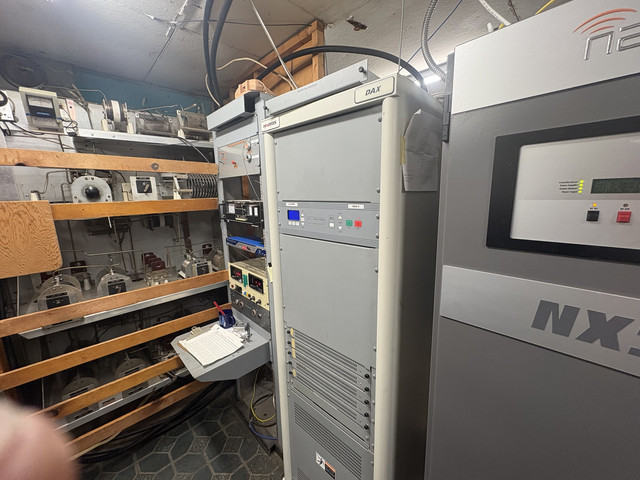
Another view of the transmitters, if you look at the NX5 above you can see by the indicator lamps it is on the air. The racks on the right and left of the transmitters contain ancillary equipment; remote control, studio to trasmitter link, modulation enhancers etc.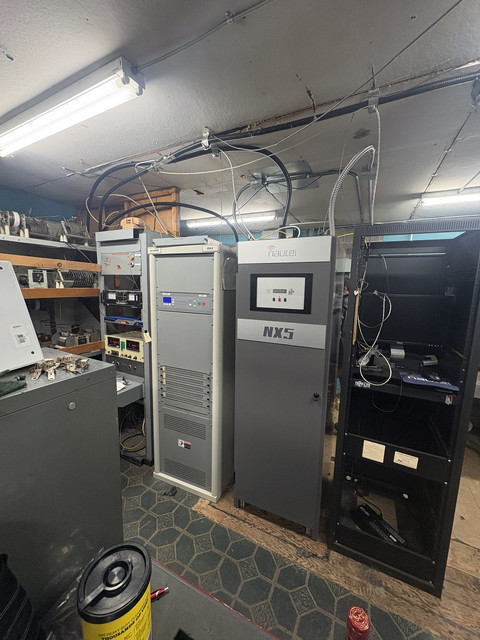
The radio frequency (RF) from the transmitter is sent to this power divider or phasing network. This is where the magic happens and the directional signal is developed. If you look closely (I hope the resolution of the photo is satisfactory) you will see labels for each tower adjustment. These coils/components are hot with RF energy hence the warning sign. Don't touch those! In newer installations this is all contained in a metal cabinet(s).
Each of the 7 towers will have its own wire and perhaps a sample line connected to the network. The way the power divider/phasor is adjusted will control the directional pattern. The towers intereact; adjust one and it will effect the others. Directional antennas require maintenance which equalls costs, there are fewer engineers with the expertise work on these rigs which might explain why when a station goes off the air it can take some time to get it operating again. This is one of the reasons many AM stations wish to switch to FM as it avoids all this. Directional arrays allowed many more AM stations to occupy the band and serve communities that would otherwise not be able to host a station. I believe this site dates back to the 60's.
Hopefully you have enjoyed this look inside. 

Last edited by darcyh (August 25, 2026 10:55 pm)
- Shorty Wave
- Member
Offline
Re: A peek inside a directional AM transmitter shack
Thanks for posting darcyh. I worked in the TV side of broadcasting, so this was all new to me, having never been around radio transmitters. It’s probably a good thing that the phasing network coils etc. are now contained in metal cabinets! Thanks again.